dimanche 27 mars 2011

""Museo de la novela de la Eterna — Macedonio Fernández, Hablando de la Eterna, un par de citas que me fascinan", por Fernando Puente


Recomendaciones literarias

sábado 18 de octubre de 2008

Museo de la novela de la Eterna — Macedonio Fernández
Hablando de la Eterna, un par de citas que me fascinan:

«Sólo aprendiz soy aun del misterio de amor que se enseña en las luces de tus ojos, y en tu movible acento, y puedo vacilar, perdido en el reconocerte por las hechicerías y mutaciones en que te transfigura la avidez de renovaciones de tu beldad eterna.»

«Los besos que me niegas muerden tus labios
»Por eso con labios uno en otro encarnizados
»Mordiéndose.
»Escribes el manuscrito de ésta tu novela en que
»te doy mi espíritu como el tuyo me diste.
»Y para lo que no pudo ser tengo tu gesto del
»divino dolor de tu No Puedo, por el cual negar
»tuyo se enterizó mi ser en plena persona, me edu-
»caste en el no “Vivir” y tanto más Amar».

El índice de la novela Museo de la novela de la Eterna, es el siguiente:

Dedicatoria a mi personaje de la Eterna
[Prólogos]
Lo que nace y lo que muere
Prólogo a la eternidad
Perspectiva
Prólogo a mi persona de autor
Andando
El autor también habla
A los críticos
Presentación para la Eterna
Hogar de la no existencia
Somos un soñar sin límite
A los lectores que padecerían si ignorasen lo que la novela cuenta
Nuevo prólogo a mi persona de autor
Prólogo que cree saber algo
Novela de los personajes
Prólogo a lo nunca visto
Salutación
Otro deseo de saludar
Cómo ha sido Posible, al fin, la novela perfecta
Deunamor
Un personaje, antes de estrenarse
Prólogo, tambiénPrólogo metafísico
El hombre que fingía vivir
Guía a los prólogos (prólogo indicador)
A las puertas de la novela (Anticipación de relato)
Entrada en prólogo de Federico
Al lector de Vidriera
Dos personajes desechados
Prólogo primero de la novela para el lector corto
A los no peritos en metafísica
Descripción de la Eterna
El fantasismo esencial del mundo
Prólogo de indecisión
Otro prólogo
Esta es la novela que principió perdiendo su «personaje cocinero» Nicolasa, renunciante por motivos elevadísimos
Novela de las cosas clausuradas, de las mudeces, de los secretos, de las fragancias guardadas, de las palabras que no suenan porque confían a un mohín o sonrisa de los labios que hablen y esa sonrisa
Prólogo del personaje prestado
Al autor (de la novela) ¿no le sucede nada?
Prólogo de desesperanza de autor
Quizagenio se lamenta de su nombre
A los personajes de mi novela
Prólogo al que se debe lectura recompensando a un autor que no deja entrar al muchacho en la novela
Qué queréis: debo seguir prólogos
Lo que me sucede
Prólogo que se siente novela
Prólogo de la pavita y el roperito
Carta genial que yo quisiera que uno de mis personajes, el Presidente, escribiera a Ricardo Nardal
¿Basta con «ir antes» para ser prólogo?
El prólogo modelo
¿Prólogo cuádruple?
El Presidente y la muerte
Al Lector Salteado
Imprecación para el Lector Seguido
Prólogo que entre prólogos se empina para ver dónde, allá lejos empieza la novela
1° Nota de posprólogo; y 2° observaciones de antelibro
Estos ¿fueron prólogos? y ésta ¿será novela?
Despierta
Comienza el tiempo de la novela
Muévese
Capítulo I
Capítulo II
Capítulo III
Capítulo IV
Capítulo V
Capítulo VI
Capítulo VII
Capítulo VIII
Capítulo IX
Capítulo X
Capítulo XI
Capítulo XII
Capítulo XIII
Capítulo XIV
Capítulo XV
Capítulo XVI
Capítulo XVII
Capítulo XVIII
Capítulo XIX
Capítulo XX
Intento de sedación de una herida que se tiene en cuenta
La novela en estados
Al que quiera escribir esta novela.

p. 235 ed. Corregidor.
Publicado por Francisco Puente en 19:24
Enviar por correo electrónico Escribe un blog Compartir con Twitter Compartir con Facebook Compartir con Google Buzz
Etiquetas: Macedonio Fernández, Museo de la novela de la Eterna
0 comentarios:

Publicar un comentario en la entrada
Entrada más reciente Entrada antigua Página principal
Suscribirse a: Enviar comentarios (Atom)
Visitas:
easy free polls
Archivo del blog

* ► 2009 (17)
o ► noviembre (3)
+ Carta de un lector a mi artículo de Labernito
+ Cuando andaba huyendo del rey de Azcapotzalco — Fr...
+ Anacando el idioma — Francisco Puente*
o ► octubre (2)
+ Arrullo al revés (Jela'an wensik) — (Lourdes Cabre...
+ De la noble esterilidad de los ingenios* — Julio T...
o ► septiembre (3)
+ Poesía en voz alta (AUDIO)
+ Poema en tu cuerpo — Elías Nandino
+ Ciego Dios — Alfredo R. Placencia
o ► junio (3)
+ Más de Sogem en crisis
+ Internet no es real, al diablo con Internet — Ray ...
+ Sogem en crisis
o ► mayo (1)
+ Benedetti y mi kitsch adolescencia‏ — Fernando Rey...
o ► marzo (4)
+ Entrevista — Mario Vargas Llosa
+ Margie, la luna es rusa... — Jaime Sabines
+ 1 — Juan Domingo Argüelles
+ Sobre las mesas: el destello* — Coral Bracho
o ► enero (1)
+ Psicología de las fotocopias

* ▼ 2008 (42)
o ► diciembre (6)
+ Debate entre setenteros — Heriberto Yépez
+ El acusado — Naguib Mahfuz
+ Carta a un viejo novelista — Heriberto Yépez
+ La comedia mexicana de Carlos Fuentes — Enrique Kr...
+ La comedia mexicana de Carlos Fuentes* — Krauze
+ Gracias Enriqueta — Angélica Santa Olaya
o ► noviembre (4)
+ Petrificada petrificante* — Octavio Paz
+ Novela y rebeldía — Albert Camus
+ - Rendón, Alejandro Cessar... — por Edu...
+ [¿Sin título?] — Inés Dashield
o ▼ octubre (5)
+ Algo dicho por Epicuro
+ Las palmeras salvajes — William Faulkner
+ Museo de la novela de la Eterna — Macedonio Fernán...
+ La muerte del Tirant: elementos para una autopsia ...
+ DEFINIENDO EL AMOR — Francisco de Quevedo y Villeg...
o ► septiembre (6)
+ la crítica* — Antonio Alatorre
+ Shu Ting Jinjiang - La línea de producción
+ Gabriela Mistral - Manos de obreros
+ Atahualpa Yupanqui - El arriero
+ Confianzas - Juan Gelman
+ Capítulo 68
o ► agosto (2)
+ De algo nos vamos a morir.
+ Mandamiento literario³*
o ► julio (1)
+ Carta a Eva
o ► junio (18)
+ dicen que es "uno de hadas" para ir leyendo*
+ ¿Publicaste hoy?*
+ De las pascuas del tiempo*
+ SONETO*
+ Cho Seung-Hui
+ Consejos a un joven novelista
+ Los errores de Cien años de soledad.(Edición conme...
+ Casi, casi.
+ EL DULCE SABOR DE UNA MUJER EXQUISITA

El que recomienda:
Mi foto

Francisco Puente
¿Datos personales? ¿Cosas como mi nip, cuenta de banco, contraseñas y esas cosas? No, pues no los anotaré.

Ver todo mi perfil
Mi red de blogs

*
Hápax poético
Cárcel y literatura (Tercera parte) Sergio Vicario.
Hace 4 días
*
Pensar y malpensar
El poder de los negros!!!
Hace 1 semana
*
Sitio de Cide Hamete Benengeli
Correcamara --Noticias--
Hace 2 semanas
*
Mil palabras son pocas
Valle Dorado, Tlalnepantla, México, México (inundado)
Hace 1 año.
*
Pura literatura
Más de Sogem en crisis
Hace 1 año.

mercredi 23 mars 2011

"AIRE LIBRE", de Luis Armando Roche en el Cervantes de Sidney


Instituto Cervantes
Instituto Cervantes de Sidney
Cultural events
Sidney
English Español
Autor/es: Luis Armando Roche
Dates

11/04/2011 (18:30 h)

Location
Instituto Cervantes
22-24 City Road
2008 Chippendale NSW
(AUSTRALIA)
Free Air: The film of Luis Armando Roche about Bonpland
film screening
In writing “AIRE LIBRE” we deliberately chose not to write an exhaustive saga, a filmed biography, a historical reconstruction or epic voyage. We shall live in the company of Humboldt, Bonpland and Juan - a teacher and their Venezuelan guide - a relatively short span of their trip through the Americas, a privileged moment in the lives of both naturalists. The film deals with the experiences lived during the first part of their trip to tropical America. But our preoccupation is not to “describe” their trip as the principal action, and much less as the subject of the film or as a curiosity, as tourism or or exotism.

Plains, jungle or small colonial village will essentially be a backdrop - in the theatrical sense - (as the photographic backdrops used by the photographers of Latin American plazas) of a truly “behind closed doors, out in the open”…. The events themselves, the encounters, the relationship with the places they visit, the shared dangers and pleasures will constitute the trigger of a collective catharsis that forces them to “open up” and affirm themselves, appreciate each other, at least, accept their differences.

In
Amado Bonpland, generator of transgenic re-writigs. book launch
Details
Title: Aire Libre: la película de Luis Armando Roche sobre Bonpland
Director: Luis Armando Roche
Year made: 1996
Format: DVD
Duration: largometraje - 96 min
País producción Venezuela
SubtituladoInglés

Participants
Eric Courthès
Entidades Organizadoras

Instituto Cervantes (Sídney)

Collaborating Organisation

The University of Sydney (Australia)

Consulado de Paraguay en Melbourne (Australia)

Free entry / Limited seating - Entrada Libre / Lugares limitados
ic.sydney@cervantes.es
Telfono reservas: (02) 9274 9200
Instituto Cervantes
22-24 City Road, Chippendale, NSW 2008, Sídney, Australia
Tlf: (+61 2) 9274 9200
Fax: (+61 2) 9274 9222
ic.sydney@cervantes.es

http://sidney.cervantes.es
http://www.cervantes.es
Instituto Cervantes

mardi 22 mars 2011

Bonpland en el Cervantes de Sidney


Instituto Cervantes
Instituto Cervantes de Sidney
Actividades culturales
Sidney
English Español
Autor/es: Servilibro-Subsecretaría de Cultura de Corrientes, Asunción, 2010
Fechas

05/04/2011 (17:30 h)

Lugar
University of Sydney (Australia)
The University of Sydney
2006 Sydney NSW
(AUSTRALIA)
"Amado Bonpland, generador de re-escrituras transgenéricas"
Presentación de libro

Eric Courthes es profesor de español en Tahití. Además de crítico literario y especialista en la obra del escritor paraguayo Augusto Roa Bastos, es novelista, traductor y lingüista. Su tesis doctoral versó sobre las influencias del quechua en el español del noroeste de Argentina. Su novela, Memorias de un muerto, el viaje sin retorno de Amado Bonpland (Asunción: Servilibro, 2010), trata sobre la vida del célebre explorador francés:


En esta conferencia Eric Courthes ofrece un recorrido por la azarosa vida de Bonpland, desde su nacimiento en Charente Marítimo, en La Rochela, Francia, su subsiguiente carrera como botánico errante y su involucración en la Guerra Grande en Argentina, partiendo del viaje mítico que compartió con Alejandro de Humboldt a comienzos del siglo XIX, en busca de las fuentes comunes del Amazonas y el Orinoco.

La conferencia resumirá la creciente bibliografía sobre Bonpland, que incluye desde biografías hasta novelas, pasando por numerosos artículos, además de obras teatrales y cinematográficas.


Finalmente, el conferenciante comentará su propia novela sobre Bonpland, un ejercicio hipertextual de fuentes históricas y ficcionales, en el cual se cuestiona la noción misma del autor, un creador en busca de un narrador-personaje llamado Bonpland que se apodera de la escritura del libro.

La conferencia será dictada en español.

Actividades conexas:

* Proyección de "Aire Libre": la película de Luis Armando Roche sobre Bonpland, el 11 de abril, en el Cervantes, seguida por un debate animado por Éric Courthès

Ficha técnica:

Título: "Memorias de un muerto, el viaje sin retorno de Amado Bonpland"
Autor/a/es/as: Eric Courthès
Editorial: Asunción: Servilibro


Participantes
Eric Courthès
Entidade Organizadoras

The University of Sydney (Australia)

Entidades colaboradoras

Instituto Cervantes (Sídney)

Consulado de Paraguay en Melbourne (Australia)

Free entry / Limited seating - Entrada Libre / Plazas limitadas
fernanda.penaloza@s
ydney.edu.au
Instituto Cervantes
22-24 City Road, Chippendale, NSW 2008, Sídney, Australia
Tlf: (+61 2) 9274 9200 begin_of_the_skype_highlighting              (+61 2) 9274 9200      end_of_the_skype_highlighting begin_of_the_skype_highlighting              (+61 2) 9274 9200      end_of_the_skype_highlighting
Fax: (+61 2) 9274 9222
ic.sydney@cervantes.es

http://sidney.cervantes.es
http://www.cervantes.es
Instituto Cervantes

dimanche 20 mars 2011

Bonpland entre grandes en SURCLA Seminar Series"" en Sidney


I. SURCLA Seminar Series

Dr Justo Díaz (Music Director, Cafe Carnivale)
“Music and Politics in the 1980: Papalote and La Peña's experience.”

When: Tuesday 22 March, 5.30pm
Where: Old Teachers College 306


Abstract
Papalote and La Peña (The Latin American Cultural Centre) were early expressions of ‘world music’ in Australia but also played an important role in the cultural politics of the 1980,s. They expressed the many exiled and displaced Latin Americans in Australia in the ‘80’s and focused on solidarity, music and politics expressing a community striving for hope, visibility and aiming to create a better world. All this in contrast with today’s market orientated trends in ‘world music’ and popular culture.

About Justo Díaz (B. Mus. Ed, M.A. UNSW, PhD UWS)

Justo Diaz is Music Director and creator of Papalote and Musica Viva's Cafe Carnivale. Justo was the Ministry for the Arts NSW Multicultural Music Coordinator and music director for Carnivale Multicultural Arts Festival until 2004. He is a multi-instrumentalist, singer, composer, researcher, educator and cultural activist. Justo has performed widely in Latin America, Spain and France, arriving to Australia in 1979 (on tour with a French Argentinean dance troupe, performing at Perth and Adelaide Festivals). He has played guitar with legendary Uña Ramos and Marián Farías Gómez.

Justo was one of the creators and music teachers of La Peña Latin American Cultural Centre in Newtown, as well as with Papalote, of one of the first multicultural music projects for schools in Australia. Justo has a collection of more than 300 musical instruments, many sourced during a research project funded by the Music Board of the Australia Council. Justo has also been a source of ideas for many projects such as "TWANG" at the Australian Museum and Café Carnivale.

As a music consultant he has worked on TV documentaries such as "South of the Border", "Tropical Beat" and "Pilgrim Notes" amongst others. He has produced music programs for SBS Radio and composed music for ABC National, for SBS TV and has made video documentaries on El Salvador, Guatemala and Australia. Justo has participated in many recording sessions singing and playing many instruments (strings, percussion and flutes).

Justo trained in Classical Guitar and in Jazz studies at the Sydney Conservatorium and completed his PHD at UWS in 2010. He created the course “From Tango to Salsa” for Sydney University and has published books of original and traditional Latin American music with Orpheus Music and an article on the local Latin American cultural scene for the Currency Companion of Music and Dance in Australia.

Nominated by SBS for Australian of the Year for 2004 awards, Justo has been a familiar face in the Australian music scene for the last 32 years, Justo frequently performs as a guest at Café Carnivale, leads his band Papalote, and also performs with Tango Bar and Cecilia Vilardo.

Note:
Access venue location by clicking on http://db.auth.usyd.edu.au/directories/map/building.stm?location=12G


II. SURCLA | COLECTIVO MUJER | Documentary Series

Continuing with this important theme, given that 2011 marks the 100th anniversary of International Women’s Day, SURCLA has joined forces with Colectivo Mujer; together, we have selected a number of documentaries which are entirely devoted to Latin American women.

Botín de guerra
(Spoils of War),
David Blaustein, 2000, 120 min [Spanish, English Subtitles]

When: Tuesday 29 March, 5.30pm
Where: Old Teachers College 306

This screening will presented by Zulema Cappielli ( from the Support Group for Madres de Plaza de Mayo)

Film Synopsis
Botín de guerra is a documentary about the ‘disappeared’ children of the last Argentine dictatorship (1976-1983), some of whom were abducted from their kidnapped parents by the military forces, whilst others were born when their mothers were in captivity in clandestine concentration camps. Hence its title: those children were the ‘spoils’ of the ‘dirty war’, systematically appropriated by those who won it, the armed forces and the police. It is estimated that more than 500 children went missing during those years, and by the time the film was made, 66 of them had been found thanks to the work of the Association ‘Grandmothers of Plaza de Mayo’. Today that number has increased to 82 cases. The film is partly a detailed chronicle of the Grandmothers of Plaza de Mayo from their beginnings in 1977 through to 2000, and their tireless work searching for their grandchildren. But it is also a document of the recent reunions, from both the grandmothers’ and the grandchildren’s perspectives.


Note:
Access venue location by clicking on http://db.auth.usyd.edu.au/directories/map/building.stm?location=12G


III. Full list of upcoming Seminars

Eric Courthès (Novelist, Literary Critic)
“Amado Bonpland: Generador de re-escrituras transgenéricas”
[This talk will be in Spanish]

When: Tuesday 5 April, 5.30pm
Where: Old Teachers College 306


Acerca de Eric Courthès
Eric Courthès es profesor de español en Tahití. Además de crítico literario y especialista en la obra del escritor paraguayo Augusto Roa Bastos, es novelista, traductor y lingüista. Su tesis doctoral versó sobre las influencias del quichua en el español del Noroeste de Argentina. Su novela, Memorias de un muerto, el viaje sin retorno de Amado Bonpland (Asunción: Servilibro, 2010), trata sobre la vida del célebre explorador francés epónimo.

Resumen de la ponencia
En esta conferencia, Eric Courthès ofrece un recorrido por la azarosa vida de Bonpland, desde su nacimiento en " Charente Marítimo, en La Rochela, y el viaje mítico que compartió con Alejandro de Humboldt a comienzos del siglo XIX en busca de las fuentes comunes del Amazonas y el Orinoco, su subsiguiente carrera como botánico errante y por último, su involucración en la Guerra Grande en Argentina. La conferencia resumirá la creciente bibliografía sobre Bonpland, que incluye desde biografías hasta novelas, pasando por numerosos artículos, además de obras teatrales y cinematográficas. Finalmente, el conferenciante comentará su propia novela sobre Bonpland, un ejercicio hipertextual de fuentes históricas y ficcionales, en el cual se cuestiona la noción misma del autor, un creador en busca de un narrador-personaje llamado Bonpland que se apodera de la escritura del libro.


About Eric Courthes
Eric Courthes is a professor of Spanish in Tahiti. A literary critic specialising in the works of the Paraguayan writer Augusto Roa Bastos, he is also a novelist, translator and linguist. He wrote his doctoral dissertation on the Quechua influences on the Spanish of Northeastern Argentina. His novel, Memorias de un muerto, el viaje sin retorno de Amado Bonpland (Asunción: Servilibro, 2010), narrates the life of the celebrated, eponymous French explorer.

Abstract
This lecture deals with Bonpland's adventurous life, from his birth in La Rochelle, Charente Maritime, and his mythical journey with Alexander von Humboldt at the beginning of the nineteenth century in search of the common sources of the Amazon and the Orinoco, through his subsequent career as a wandering botanist and at last, his involvement in Argentina's Great War. The lecture summarises the growing bibliography about Bonpland, which includes biographies, novels, and numerous articles, as well as plays and films. Eric Courthès also discusses his own novel about Bonpland, an hypertextual experiment based upon historical and fictional sources which interrogates the very notion of "the author", a creator in search of a narrator-protagonist called Bonpland who appropriates the writing of the book in question.


Gabina Funegra (University of New South Wales)
“Quechua: the Fading Inca Language”


When: Tuesday 19 April, 5.30pm
Where: Old Teachers College 306
Abstract
Gabina Funegra will present her award winning documentary, QUECHUA – THE FADING INCA LANGUAGE. The documentary captures the passing of the Quechua language in a remote mining town, Huallanca, high in the Peruvian Andes. Once the language of the great Inca Empire, the documentary reveals the abandonment of Quechua in Peru. This is Gabina Funegra’s first documentary and it is a personal journey to the place of her mother’s indigenous origins. Along with her daughter, Gabina travels to this remote village to discover her mother’s language and find the resilience of a small indigenous community and their fading language. The film is the result of original research conducted on linguistics policies in Peru and the use of the Quechua language in the central Andes of Peru. The documentary explores the changing attitude of people and the impact of language on identity. The film was co-produced with Ms Fuengra’s daughter, Erika Bonifaz.This is a bilingual session in English and Spanish. Ms Funegra will discuss her experience of producing the documentary and her research. The session includes a screening of the documentary, and question time.


Fernando Serrano (University of Sydney)
“Challenging or Reshaping Heteronormativity with Public Policies? A Case Study from Bogotá, Colombia”


When: Tuesday 3 May, 5.30pm
Where: Old Teachers College 306
Abstract
On 28 December 2007 the then Mayor of Bogotá signed a Decree which established the guidelines of the public policy for the full guarantee of the rights of lesbian, gay, bisexual and transgender (LGBT) people in the city. This legal
measure was the end point of a long lobbying and advocacy strategy implemented by activists and organisations working on gender and sexual diversity. This Paper presents that experience as part of the process in
which subordinated social sectors, such as gender diverse and sexually diverse people make themselves political subjects. In spite of the novelty in Colombia and in Latin America of this kind of public policy targeting LGBT
people as subjects of rights, it is also an opportunity for normative systems to readjust and to create new ways to normalise people. The promotion of certain queer people as proper citizens, the regulation of ways to interact with the
state, the co-option of social mobilisations and the transformation of grassroots organisations into private service providers, are just some of the risks that a scheme like this faces. The author was part of the social mobilisation that
motivated this particular public policy scheme in the early 2000s and was involved in its design, planning and initial implementation between 2007 and 2010. This paper is situated in a problematic position between political
activism, consultancy work and construction of knowledge based on the practice. It is a contribution to the memory of a rich, and in many ways unique, experience.


Annick Pellegrin (University of Sydney)
“Do You Think US Comics are the Only Ones With Strong Men?”: Traitors and National Heroes in Rius’s Los Supermachos and the (de)Configuration of the Mexican Nation.


When: Tuesday 17 May, 5.30pm
Where: Old Teachers College 306

Abstract
Early issues of the comic series Los Supermachos, by Rius, often refer to the “supermales”, Superman and the importance of the Olympics (2004d: 9; 2004c:117). In these episodes, the inhabitants of the fictional village of San Garabato remind each other that “we must put up with absolutely everything!” (2004b: 52, my translation). The character who best explains this attitude is Calzónzin: “[Cuauhtémoc] was our very hero…! And to honour him we behave like supermales! We don’t have food, but we endure it!… We are pestered by despots, by the police, by the rich… but we endure it!” (2009b: 49, my translation). Don Perpetuo, for his part, is a malinchista who nationalises industries by encouraging foreign investment (2004a: 324). Bearing in mind that the nation is synonymous with machismo in this symbolic and historical configuration, a fact that implies the need to go through a rite of passage before reaching masculinity, and that the 1968 Olympics (and the notorious Tlatelolco massacre that came with them) were considered to be a way for Mexico to prove itself, what are the implications of the use of the term “supermale” in this famous comic series? What do the Olympics, with respect to their repercussions on Mexican history at the political level, have to do with being a supermale? (Lewis 2009a: 184; Brewster & Brewster 2006a: 107) If being a supermale entails enduring everything, how is it that Rius got into trouble with censorship? What critique of the institutionalised image of the nation, and its associated mythical hypermasculinity, both promoted for a long time by the state under PRI rule (Institutional Revolutionary Party, 1924-2000), comes to be understood in the male iconicity which is ridiculed through Rius’s work? Using an approach informed by queer and decolonial critique, these are the questions that I propose to explore in this talk.


Claudia Alarcón (University of Sydney)

“Television, Gender and the Representation of Tragedy: the 2010 Earthquake in Chile”
[This talk will be in Spanish and English]

When: Tuesday 31 May, 5.30pm
Where: Old Teachers College 306

Abstract
This paper is based on empirical findings resulting from an on-screen content broadcast survey conducted by the National Television Council of Chile. Drawing on both, quantitative and qualitative research methodologies, the focus of this presentations is on the media coverage of the catastrophic earthquake that struck Chile in February 2010, which is one of the most severe in the country's history. According to some reports, the magnitude-8.8 quake was felt by 3-million people. Though the tsunami that struck coastal cities around the Pacific was relatively minor, the Chilean government estimates that the earthquake left 2-million people homeless. This study focuses on gender constructions and the television coverage of this catastrophic event. The paper offers an insight on gender inequality in media representation, and therefore, it raises questions on the participation and position of women in the media, and the persistence of patriarchal structures in society which, in turn, challenge the full application of democratic values in Chile.


IV. Full list of upcoming Documentary Screenings – SURCLA | COLECTIVO MUJER


Poto Mitan, Haitian Women: Pillars of the Global Economy
Renée Bergan & Mark Schuller, 2009, 50 min [French, Creole with English Subtitles]

When: Tuesday 12 April, 5.30pm
Where: Old Teachers College 306

Film Synopsis
Told through compelling lives of five courageous Haitian women workers, Poto Mitan gives the global economy a human face. Each woman's personal story explains neoliberal globalization, how it is gendered, and how it impacts Haiti: inhumane working/living conditions, violence, poverty, lack of education, and poor health care. While Poto Mitan offers in-depth understanding of Haiti, its focus on women's subjugation, worker exploitation, poverty, and resistance demonstrates these are global struggles. Finally, through their collective activism, these women demonstrate that despite monumental obstacles in a poor country like Haiti, collective action makes change possible.


Made in LA
Almudena Carracedo, 70 min [Spanish, English Subtitles]

When: Tuesday 10 May, 5.30pm
Where: Old Teachers College 306

Film Synopsis
Made in L.A. is an Emmy award-winning feature documentary that follows the remarkable story of three Latina immigrants working in Los Angeles garment sweatshops as they embark on a three-year odyssey to win basic labor protections from a trendy clothing retailer. In intimate verite style, Made in L.A. reveals the impact of the struggle on each woman’s life as they are gradually transformed by the experience. Compelling, humorous, deeply human, Made in L.A. is a story about immigration, the power of unity, and the courage it takes to find your voice.

La Batalla de las cruces
(Battle of the Crosses)
Rafael Bonilla Pedroza, 2005, 82 min [Spanish with, English Subtitles]

When: Tuesday 24 May, 5.30pm
Where: Old Teachers College 306

This screening will presented by Sydney Action for Juárez


Film Synopsis
This film is the product of research undertaken by a group of social scientists led by Patricia Ravelo Blancas, from the Centre for Research and Studies in Social Anthropology, Mexico. The documentary attempts to list or catalogue the myriad complex intersecting sets of public and private actors who, with massive amounts of private money and political power at their disposal, managed to directly or indirectly violate the human rights of scores of young Mexican women, their families and defenders, falsely accused defendants, their murdered lawyers, and journalists without anyone being held accountable. This documentary is invaluable for illuminating the context surrounding the hundreds of murders and disappearances of women in Juárez.


Dr FERNANDA PEÑALOZA| Lecturer in Latin American Studies &
Coordinator of SURCLA (Sydney University Research Community for Latin America)
Spanish and Latin American Studies |School of Languages and Cultures

THE UNIVERSITY OF SYDNEY
Rm No,722 Brennan MacCallum A18 | The University of Sydney | NSW | 2006
T +61 2 9351 6893 | F +61 2 9351 2319
E fernanda.penaloza@sydney.edu.au |
W http://www.arts.usyd.edu.au/spanish_latin_american/staff/profiles/penaloza.shtml

samedi 19 mars 2011

“Amado Bonpland: Generador de re-escrituras transgenéricas”, Eric Courthès, SURCLA (Sidney University Research community for Latin America), 5 de abri


EN MEMORIA DE MI AMIGO AUGUSTO ROA BASTOS
Just another WordPress.com site
Saltar al contenido
* Inicio
* Acerca de

← “”La guerra de todos contra todos” del Señor Hobbes”, Alejandro Maciel


“Amado Bonpland: Generador de re-escrituras transgenéricas”, Eric Courthès, SURCLA (Sidney University Research community for Latin America), 5 de abril de 2011

Publicado el 14 marzo, 2011 por eroxacourthes

SURCLA (Sydney University Research Community for Latin America)
Seminar Series 2011

Eric Courthes (Novelist, Literary Critic)

“Amado Bonpland: Generador de re-escrituras transgenéricas”
[This talk will be in Spanish]

When: Tuesday 5 April, 5.30pm
Where: Old Teachers College 306

Acerca de Éric Courthès:

Eric Courthès es profesor de español en Tahití. Además de crítico literario y especialista en la obra del escritor paraguayo Augusto Roa Bastos, es novelista, traductor y lingüista. Su tesis doctoral versó sobre las influencias del quichua en el español del Noroeste de Argentina. Su novela, Memorias de un muerto, el viaje sin retorno de Amado Bonpland (Asunción: Servilibro, 2010), trata sobre la vida del célebre explorador francés del título.

http://www.servilibro.com.py/v2/detalles_libro.php?id_catalogo_libro=1004

Resumen de la ponencia:

En esta conferencia Eric Courthes ofrece un recorrido por la azarosa vida de Bonpland, desde su nacimiento en Charente Marítimo, La Rochela, Francia, desde el viaje mítico que compartió con Alejandro de Humboldt a comienzos del siglo XIX en busca de las fuentes comunes del Amazonas y el Orinoco, su subsiguiente carrera como botánico errante en el Cono Sur hasta su involucración en la Guerra Grande en Argentina. La conferencia resumirá la creciente bibliografía sobre Bonpland, que incluye desde biografías hasta novelas, pasando por numerosos artículos, además de obras teatrales y cinematográficas. Finalmente, el conferenciante comentará su propia novela sobre Bonpland, un ejercicio hipertextual de fuentes históricas y ficcionales, en el cual se cuestiona la noción misma del autor, un creador en busca de un narrador-personaje llamado Bonpland que se apodera de la escritura del libro.

About Eric Courthès:

Eric Courthes is a professor of Spanish in Tahiti. A literary critic specialising in the works of the Paraguayan writer Augusto Roa Bastos, he is also a novelist, translator and linguist.He wrote his doctoral dissertation on the Quichua influences on the Spanish of Northeastern Argentina. His novel, “Memorias de un muerto, el viaje sin retorno de Amado Bonpland” (Asunción: Servilibro, 2010), narrates the life of the celebrated, eponymous French explorer.


AnteriorToggle PlaybackSiguiente

Abstract:

This lecture deals with Bonpland’s adventurous life, from his birth in La Rochelle, Charente Maritime, from his mythical journey with Alexander von Humboldt at the beginning of the nineteenth century in search of the common sources of the Amazon and the Orinoco, through his subsequent career as a wandering botanist and his involvement in Argentina’s Great War. The lecture summarises the growing bibliography about Bonpland, which includes biographies, novels, and numerous articles, as well as plays and films. Eric Courthès also discusses his own novel about Bonpland, a hypertextual experiment based upon historical and fictional sources which interrogates the very notion of “the author”, a creator in search of a narrator-protagonist called Bonpland who appropriates the writing of the book in question.

Éric Courthès también presentará la película venezolana de Luis Armando Roche, sobre la expedición del Orinoco al Amazonas, de Humboldt y Bonpland, “AIRE LIBRE”, en el Instituto Cervantes, el 11 de mayo de 2011.

Eric Courthès will present too venezolan picture of Luis Armando Roche, on Orinoco and Amazon Expedition, of Humboldt and Bonpland, “AIRE LIBRE”, in Cervantes Institure, on 11 may 2011.
Esta entrada fue publicada en Sin categoría y etiquetada Amado Bonpland, endotexto, Eric Courthès, exotexto, hipertexto, SURCLA Sidney. Guarda el enlace permanente. Editar
← “”La guerra de todos contra todos” del Señor Hobbes”, Alejandro Maciel
Like
Be the first to like this post.
Una Respuesta a “Amado Bonpland: Generador de re-escrituras transgenéricas”, Eric Courthès, SURCLA (Sidney University Research community for Latin America), 5 de abril de 2011

1.
maigredelestuaire dice:
18 marzo, 2011 a las 9:14 (Editar)

nous bons drôles du coin sommes fiers de notre écrivain du coin, le canard. Un bon drôle ce torchus qu’a fait des beaux voyages dans l’monde des autres que nous qu’on ne connaît pas.
zavons beu li cheu live de bonpland et qu’avons-nous adoré.
vive la lybie libre
ergaim kcire, un drôle de l’océan vide
Responder

Deja un comentario Cancelar respuesta

Conectado como eroxacourthes. ¿Quieres salir?

Comentario

Puedes usar las siguientes etiquetas y atributos HTML:


Eres el autor de esta entrada.

*
Buscar por:
*
Entradas recientes
o “Amado Bonpland: Generador de re-escrituras transgenéricas”, Eric Courthès, SURCLA (Sidney University Research community for Latin America), 5 de abril de 2011
o “”La guerra de todos contra todos” del Señor Hobbes”, Alejandro Maciel
o “El origen mestizo de San Martín”, Hugo Chumbita
o “Ferdydurke”, Witold Gombrovicz
o “ESCRITURAS AXIOLÓGICAS EN “EL TRUENO ENTRE LAS HOJAS”", Eric Courthès
*
Archivos
o marzo 2011
o enero 2011
o diciembre 2010
o noviembre 2010
o octubre 2010
o septiembre 2010
o agosto 2010
o julio 2010
o junio 2010
o mayo 2010
o abril 2010
o marzo 2010
o diciembre 2009
o noviembre 2009
o octubre 2009
o agosto 2009
o julio 2009
o abril 2009
o marzo 2009
o enero 2009
o diciembre 2008
o noviembre 2008
o septiembre 2008
o agosto 2008
o julio 2008
o junio 2008
o mayo 2008
o abril 2008
o marzo 2008
o febrero 2008
o enero 2008
o diciembre 2007
o noviembre 2007
o octubre 2007
o septiembre 2007
o agosto 2007
o julio 2007
o junio 2007
o mayo 2007
o abril 2007
o marzo 2007
o febrero 2007
o enero 2007
o diciembre 2006
o noviembre 2006
o octubre 2006
o septiembre 2006
o agosto 2006
o julio 2006
o junio 2006
o mayo 2006
o abril 2006
o marzo 2006
o febrero 2006
o enero 2006
*
Categorías
o Actualités et politique
o Aimé Bonpland
o Amado Bonpland
o Article de journal
o Article sur le quichua de Santiago del Estero, Eric Courthès, Crisol n° 3, Paris X,19999
o Article sur Roa
o écrivains argentins
o Cours sur Arguedas
o Cours sur Bolaño, "Nocturno de Chile", PAF espagnol, Mayotte, 2007
o Divertissement
o Documentaire sur Roa Bastos
o Entretenimiento
o Entrevista de Roa
o Essai sur Roa
o FOTOS DE MI SAGRADA FAMILIA
o Libros
o Livres
o Música
o Musique
o Ordinateurs et Internet
o Organisations
o Poesía
o Projet pédagoqique sur Roa
o Santé et bien-être
o Sarkousette le Suprême
o Sin categoría
o Théâtre
o Traduction inédite de Roa Bastos
o Voyages
o X Congrès du CELCIRP, Charlottetown, CANADA, 6-8 juin 2006
*
Meta
o Administrador del sitio
o Desconectar
o RSS de las entradas
o RSS de los comentarios
o WordPress.com

EN MEMORIA DE MI AMIGO AUGUSTO ROA BASTOS
Tema Twenty Ten Funciona con WordPress.

*
* Mi cuenta
o New QuickPress Post
o Editar mi perfil
o Read Freshly Pressed
o Read Posts I Like
o Leer mis suscripciones
o Administrar mis suscripciones
o Track My Comments
o Escritorio global
o Get Support
o Cerrar sesión
* Mi sitio
o Escritorio
o Nueva entrada
o Site Stats
o Gestionar comentarios
o Read Blog
o Register a New Blog
* Current blog avatar
* Información del blog
o Artículo al azar
o Obtener enlace corto
o Marcar como 'spam'
o Reportar como contenido adulto
* [x] Subscribe
o Unsubscribe from Blog
* Like
* Editar

This Site All Sites

jeudi 17 mars 2011

À propos d'Insula : réflexions Entretien d'Érika Nimis avec Jérôme Havre Montréal, février 2011

Publicité

plus d'infos en lien avec cet article

redacteursErika Nimis
personnesJérôme Havre

A lire aussi ...

Insula : réflexions de Jérôme Havre

© Paul Litherland

Insula : réflexions de Jérôme Havre

© Paul Litherland

Insula : réflexions de Jérôme Havre

© Paul Litherland

Insula : réflexions de Jérôme Havre

© Paul Litherland

Insula : réflexions de Jérôme Havre

© Paul Litherland

Opening, Jérôme Havre au MAI

© Érika Nimis

10|03|2011entretien > arts plastiques
imprimer | retour

À propos d'Insula : réflexions Entretien d'Érika Nimis avec Jérôme Havre Montréal, février 2011

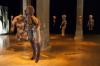
Fin 2010 au MAI (Montréal Arts Interculturels), l'artiste Jérôme Havre proposait, dans un tourbillon de matières et de couleurs, une installation sur l'insularité, un espace géographique qui invitait à l'introspection, dans un rapport de l'intérieur avec l'extérieur. Insula : réflexions a été envisagée par l'artiste comme une entente sémiotique et spatiale pour parler d'isolation, d'histoire, de déplacement, de migration et de représentation.


Comment vous est venue l'idée de ce projet d'exposition ?

L'idée de ce projet m'est venue d'une volonté de mettre en relation des questionnements identitaires et une manière que j'ai de travailler qui nécessite l'isolement. Cette dernière isolation n'était évidemment pas stérile, puisqu'elle m'a permis de faire éclore le travail que je présente. L'instrument que j'ai utilisé le plus souvent, l'aiguille à coudre, m'a plongé dans une routine hypnotisante : loin d'aspirer mes forces, le processus de piquer le tissu a entraîné un flot de pensées que je traduisais par écrit et qui se manifestaient sous forme de réflexions qui me poussaient à aller toujours plus loin dans l'action. En conséquence, l'installation Insula : réflexions est la trace matérielle et conceptuelle de ces nombreuses périodes de repli.

Dès le titre, vous semblez jouer sur plusieurs registres, en jouant sur les mots. Au-delà de l'insularité, votre exposition nous plonge-t-elle dans les tréfonds de votre cerveau / votre mémoire / vos émotions ?

En effet, l'insula correspond à des territoires, les îles, mais aussi à des immeubles d'habitation dans la Rome antique, de même qu'à la partie du cerveau appelée cortex insulaire qui serait le producteur d'émotions. Ces trois concepts ont guidé mon choix quant au titre. Je voulais un titre qui soit concret, sans pour autant être manifeste. En outre, je voulais qu'il évoque les causes et les conséquences. Néanmoins, si mon désir dans ce travail est de mieux comprendre la place que j'occupe dans un système et les structures sur lesquelles je tiens en équilibre, il est aussi la mise en forme d'émotions qui invoquent le sens commun et la méditation. C'est pourquoi j'ai préparé, avec le titre, l'immersion du spectateur, sans forcer.

Vous accumulez les médiums (sculpture, peinture, photographie, son), de même que les matériaux (nylon, kapok, céramique) dans vos sculptures. Que suggère cette accumulation ?

Cette concentration de médiums et de matériaux est un moyen d'articuler et d'agencer ce qui habituellement se distingue dans un espace commun. C'est la somme des instruments artistiques et des matériaux dont je me sers dans une correspondance spatiale et d'intention. En outre, elle révèle, en raison de ces composants, la structure de mon travail dans laquelle les œuvres intimistes, créées indépendamment de l'environnement, laissent apparaître les temps de création en filigrane. Mentionner l'immersion dans mes installations est intentionnel : je désire plonger l'observateur dans un univers complet où tous ses sens sont en éveil.

Le ressac de la mer pour fond sonore appuie plus encore l'idée d'insularité, ou y a-t-il un autre message derrière ce bruit qui semble anodin de prime abord ?

Cette trame sonore est un élément nécessaire à la contemplation et, comme vous l'avez noté, il s'agit du ressac de la mer. Je voulais qu'on puisse imaginer la progression des vagues, leur avancée et leur interruption brusque devant un obstacle, mais plus personnellement c'est un son qui m'évoque la Martinique dont je suis originaire. J'aime à penser qu'un visiteur pourrait profiter du moment qu'il passe dans l'exposition et se laisser attirer par l'atmosphère apaisante pour faire un bref voyage.

Pouvez-vous nous dire quelques mots sur ce mur peint qui entoure votre installation ?

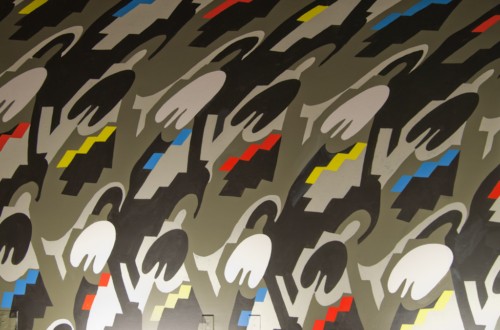
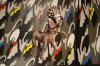
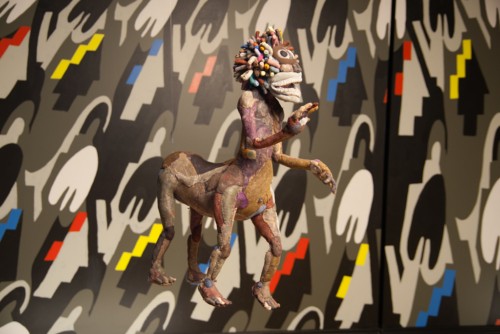
La peinture murale qui sert d'enceinte est composée d'un motif qui se répète. Ce wall painting est ce qui subsiste d'une proposition antérieure plus complexe, qui reprenait des motifs en relation avec les habitudes de consommation et les pratiques quotidiennes dans les espaces domestiques en France et en Hollande au 19e siècle. J'ai alors pensé cette frise murale comme une plateforme visuelle et flottante pour une lecture tridimensionnelle et immersive. L'effet visuel recherché dans la répétition de ce motif inspiré des textiles arts déco est un mouvement ondulatoire qui renvoie à la mer.

Sur les murs, vous semblez présenter la version "réfléchie" de votre œuvre, alors qu'au centre de la pièce, les sculptures semblent davantage renvoyer aux émotions, à l'insula. Est-ce bien cela ?

En effet, j'ai séparé l'espace d'exposition, afin de faire du centre de l'installation une terre et consacrer le pourtour à un territoire géopolitique qui serait la mer, opposer ainsi froid et chaud, liquide et solide, écho et silence, raison et intuition. C'est ainsi que les murs recouverts de motifs peints et baignés d'une lumière froide contrastent dans un même espace avec le territoire principal dont la lumière chaude rassure, jouant ainsi d'un mouvement de va-et-vient, de l'horizon en son centre. Néanmoins, c'est dans une volonté de complémentarité des dispositifs de mise en scène que tout se joue.

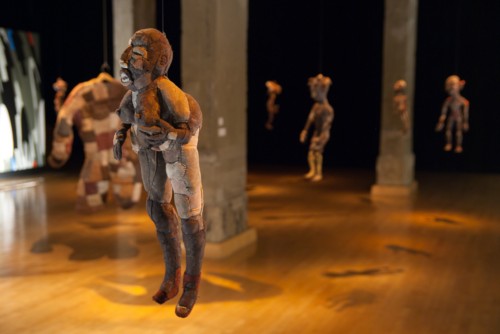
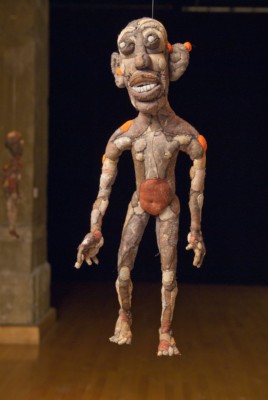
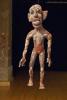
La partie la plus organique de votre œuvre est ces poupées "hybrides". Sous leurs dehors à la fois monstrueux et fantastiques, leur texture, colorée et chaude, vivante, leur proximité (suspendues à un fil, elles nous font face), font que très vite on les "apprivoise"… Est-ce l'effet recherché ?

Le dispositif d'installation est pensé comme un parcours initiatique où le public participe à l'espace au même titre que les œuvres : ainsi les poupées de la série Hybrides se laissent approcher. La proximité a pour but d'encourager le public à embrasser le tout et à se fondre dans l'installation. Se tenir à distance des œuvres est généralement exigé, afin de réduire les risques d'accident, or dans cette installation, le rapprochement est encouragé, afin de provoquer un dialogue entre ciel et mer, dans un ballet qu'ouvrent les sculptures suspendues.

Dans vos œuvres, tous les visages sont déformés ou masqués, sauf ce portrait de femme auquel vous associez le terme de cameo appearance, caméo en français, qui désigne une apparition fugace dans un spectacle de théâtre ou un film. Cela veut-il dire qu'il est impossible de montrer son vrai visage et que l'on est condamné aux apparences ?

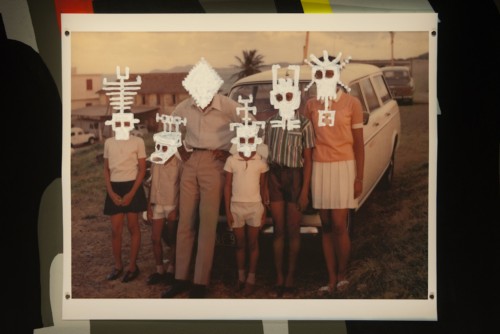
Le masque est effectivement un signe qui se répète dans mon travail, sous forme d'expressions accentuées dans le cas des sculptures de la série Hybrides, tandis que pour les photographies, il se laisse découvrir sous un aspect à la fois plus intime et plus coutumier. Ainsi, la première photographie découvre un groupe de six personnes qui font face à la caméra et dans laquelle les figures sont masquées, recouvertes d'une peinture blanche qui reprend sommairement les contours de masques africains types, tandis que l'autre est un portrait de trois quarts, en noir et blanc, plus grand que nature, sur fond jaune sur lequel en superposition est dessiné à la main le titre : cameo appearance. Ces travaux se veulent ouvertement contradictoires, en faisant un pied de nez à l'histoire coloniale. Ces masques dissimulent pour mieux montrer.

Le thème de la peau est constamment présent dans votre œuvre sculpté (avec notamment la série Hybrides et cette autre œuvre Contour subjectif), de même que dans le Nuancier photographique que vous avez réalisé en 2001. Pouvez-vous nous en dire plus ?

La peau comme symbole est devenue un instrument de travail depuis une douzaine d'années. Elle a été un axe où d'autres questions ont surgi. C'était un moyen visuel, facteur de sens qui m'a permis d'évoquer les notions de race, de racisme, d'aborder des sujets comme la discrimination, l'histoire, l'éducation, la sensualité. Le derme et sa couleur se sont développés dans mon travail, sous forme de vidéo, de sculptures, d'impressions numériques, de tirages photographiques comme le Nuancier de peau qui était un moyen de mettre à plat à petite échelle un panel de formes et de couleurs sous forme de paysage imaginaire. Depuis 1999, mon sujet s'est caractérisé par son élasticité et m'a permis de développer un corpus d'œuvres regroupé sous un seul titre : Magnifique Isolation.

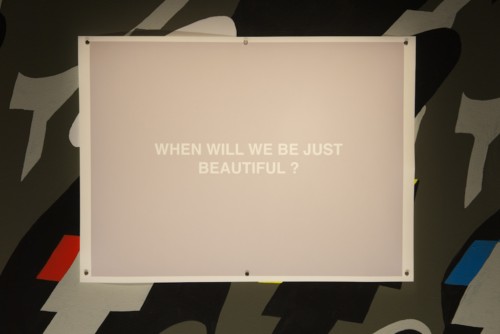
Vos œuvres murales renvoient aux politiques discriminatoires qui ont notamment sévi au 20e siècle. En citant "Only for colored people", ou en posant la question : "When will we be just beautiful ?", quels messages souhaitez-vous faire passer dans votre exposition ?

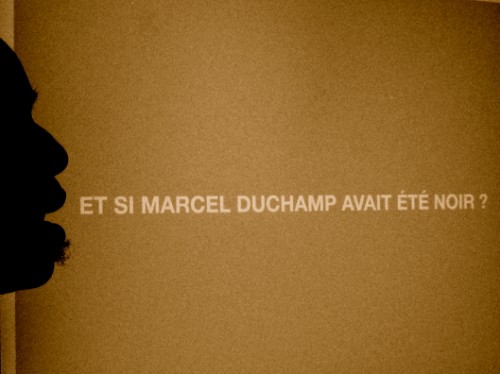
Ces questions apparaissent dans l'exposition, imprimées sur des affiches, et placent le spectateur au croisement de l'art et de la pensée raciale. L'art a-t-il une histoire racialisée ? À cause du racisme, des artistes talentueux, parce qu'ils étaient noirs, n'ont-ils pas été ignorés, et l'art n'a-t-il pas été retardé, et je dirais même, la société entière n'a-t-elle pas été retardée dans son évolution ? Ainsi, c'est l'artiste qui devient le cœur de l'interrogation, en tant qu'être humain : même dans l'art, il y a de la ségrégation, et les affiches dénoncent cela.

"Si Marcel Duchamp avait été noir ?" Pourquoi avoir choisi Marcel Duchamp pour dénoncer cette ségrégation persistante dans le milieu de l'art ou dans la société en général ?

Je me suis particulièrement intéressé à Marcel Duchamp quand j'ai découvert son alter ego Rrose Sélavy, personnage où il incarnait une femme, de culture et de confession juive. Pour l'affiche "si Marcel Duchamp avait été noir ?", il était nécessaire de trouver un artiste qui s'attache plus à un concept, pour mettre en équilibre les espaces que j'opposais. Marcel Duchamp est une figure marquante de l'art qui casse avec la tradition du labeur académique. C'est un nom qui résonne dans le petit milieu artistique occidental, même si ce dernier retient souvent plus le prestige qui découle du nom de l'artiste (ah, c'est Duchamp donc c'est forcément du signe) que le travail lui-même. Ma volonté était de passer d'une référence spécifique à une réflexion générale sur un problème de fond, celui des discriminations dans un cadre artistique et par extension dans nos sociétés. On me rétorquera que cette question aurait gagné à être posée dans des contextes artistiques plus fédérateurs. Par exemple, "What if Mozart was black ?", et le cas s'est effectivement présenté avec le Chevalier de Saint-George, certes un métis selon la terminologie raciale, mais qui a eu le "malheur" de disparaître au moment où Napoléon Bonaparte rétablissait l'esclavage en France. Pour résumer, si l'affiche concentre bien la question sur un individu, je suis tenté de dire qu'il n'y a pas que lui.

ajoutez un avisvotre avis


Share |